|
Biography
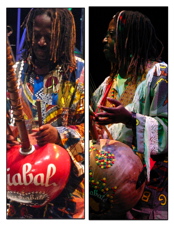
Prince Diabaté hails from a prominent, Malinké family
from Guinea, West Africa. He learned his art from his father, Djéli
Sori Diabaté. Breaking with tradition, his father also taught
Prince's mother, Hadja Djéli Sira Cissoko, to play kora. The
young boy became an exceptionally early starter by accompanying his
parents to their concerts throughout West Africa. Despite his father's
disapproval, he decided to make music his life. When he was eight years
old, former Guinean President, Sekou Touré, came to his home
town, Kindia, for a celebration in Independence Square. Braving the
outraged soldiers and his own fear, the young musician grasped his kora,
threw himself at the President's feet and played a special song for
him. Greatly touched by his skill and audacity, Sekou Touré became
his benefactor, enrolling him into the National Children's Theatre in
Conakry. At 16 years of age, in Abidjan, Ivory Coast, he stumbled upon
a videocassette of Jimi Hendrix and, inspired by what he heard, entered
an international kora competition. Taking first prize that day he became
known as 'Prince Diabaté, Prince of the Kora.'
|
 |
|
In 1986 he met the singer, Amara Sanoh, and the two started to
perform together.In 1990 he won the "Découvertes" Award,
sponsored by Radio France Internationale. After 12 successful years
on the international festival circuit, touring in Africa, Europe, Canada
and the USA the duo disbanded and Prince Diabate settled in Los Angeles,
USA. Prince Diabate has released four studio albums: Lamaranaa (Buda
Musique/Allegro) in 1993, New Life (Sunrise Records/Orchard)
in 2001, which features guest artists Michael Brook and Hassan Hakmoun;
Djerelon (Kora Company Collection) was recorded in Guinea,
Conakry in 2006 and is arranged and produced by the late Kante Manfila,
longtime collaborator of Salif Keita.The album won the People's Choice
Awards (Vox Populi)
in the Independent Music Awards for 2007: World Music (Traditional)
category.
His latest album, My Music,
was recorded in Guinea, Conakry in 2022 and features Guinean and French
artists. It was mixed in France and mastered in the USA.
Considered to be one of the leading kora players of his generation,
Prince Diabaté brings not only total mastery over his ancestral
tradition, but a commitment to renew it through fresh ideas and exchanges
with musicians from many cultures. His years in the USA produced collaborations
with artists and groups as diverse as The New Mexico Symphony Orchestra,
Adam del Monte (Flamenco), Grammy winner, Ozomatli (Hip-Hop/Latin rock)and
Grammy nominee, Michael Brook. The musically adventurous griot has incorporated
reggae, rap and blues into his work occasionally punctuated by the funky
use of the wah-wah pedal. Lately he has adapted the music of the Wassolou
to his repertoire, which he plays, self-taught on the kamelen n'goni,
a traditional hunters' harp. The result is entirely his own creation:
a fresh, powerful brand of twenty-first century Manden music, which
remains strongly rooted in traditional codes and references.
His
work has attracted grants from Arts International; Alliance for California
Traditional Arts; Los Angeles County Arts Commission, Los Angeles Cultural
Affairs Department and the Durfee Foundation. Prince Diabate also maintains
an active schedule as a lecturer on aspects of Mandinka music. He is
also sought after for film and television projects in Hollywood including
previous work with Academy Award winner Hans Zimmer & Grammy Award
winner Heitor Pereira.
These days Prince Diabaté divides his time between France, the
USA and Guinea and is often on the move, performing with his group.
At the
end of 2013 the Prince Diabate Music Academy was officially launched
in Guinea. This new academy, the first privately-funded establishment
in Guinea, is the result of Prince Diabaté's desire to create
an international music school specializing in stringed instruments and
traditional flute. Construction is still underway and an official opening
is scheduled for 2026/2027.
BIOGRAPHIE (VERSION FRANCAISE)
Prince Diabaté, joueur de kora,
chanteur, compositeur de Guinée, Conakry, est connu comme l'un
des pionniers de la kora "alternative" grâce à
un parcours musical riche et singulier. Issu d'une grande famille de
griots malinké de la Guinée, Conakry. Prince Diabaté,
a commencé son apprentissage à la kora dès l'âge
de 5 ans auprès de son père, Djeli Sory Diabaté
. Rompant avec la tradition, son père a également enseigné
la mère de Prince, Hadja Djeli Sira Cissoko, à jouer à
la kora et le petit Diabaté est devenu apprenti exceptionnellement
précoce en accompagnant ses parents à leurs concerts à
travers l'Afrique de l'Ouest. Mais Djeli Sory ne voulait pas que son
fils cadet soit musicien comme lui; il aurait préféré
qu'il fasse ses études, qu'il apprenne un métier. Alors
le jeune fonceur a été obligé d'apprendre à
jouer à la kora en secret. Mais, à l'âge tendre
de 9 ans, prenant son destin musical en main, le jeune virtuose a attiré
l'attention de l'ancien Président, Ahmed Sékou Touré,
qui a amené son protégé lui-même à
la capitale, Conakry, pour l'inscrire au Théâtre National
d'Enfants .
Suite à sa formation, Prince Diabate avait à peine 16
ans quand il se trouvait “en aventure” à Abidjan,
Côte d'Ivoire. Invité à se présenter au Concours
International de Kora, et inspiré d'une vidéo-cassette
de Jimi Hendrix qu'il avait découvert, il remporta le premier
prix du concours et devenu, ce jour, « Prince
Diabaté, Prince de la Kora » Ce concours
fit basculer sa carrière car, désormais, il acquiert aussi
le surnom “Jimi Hendrix de la Kora”autant
pour sa technique élaborée qui fait de son instrument
à la fois une basse, une percussion, une harpe, que pour la relation
particulière entre lui et sa kora.
En 1986 Prince Diabate a formé un duo avec le chanteur guinéen,
Amara Sanoh, et ils ont commencé à se produire un peu
partout en gagnant de nombreux prix, dont notamment “Découvertes
90,” sponsorisé par Radio France Internationale. En 1993
ils sortent un album intitulé “Lamaranaa,”
enregistré à Paris chez Buda Musique. Le succès
de ce disque impose Prince Diabaté comme l'un des joueurs de
kora le plus talentueux de la nouvelle génération et lance
le duo sur le plan international, en leur donnant l'occasion de se faire
remarquer sur les grandes scènes en Europe, en Afrique, au Canada
et aux EUA.
Lorsque le duo se dissout en 1998, Prince Diabaté a décidé
de rester aux Etats-Unis pour y recréer sa carrière. Enrichi
de ses collaborations et rencontres avec des artistes américains,
il fonde un nouveau groupe, tout en développant sa signature
personnelle « Jimi Hendrix » marquée par
un pédale de wah-wah qu'il branche à sa kora . En 2001
son deuxième album, “New Life” sort.
Enregistré entre New York et Los Angeles, “New Life”
(style “World Music”) est un disque basé sur ses
racines mandingues, mais influencé par une modernisation de genres
musicaux, comme reggae, rap, blues, flamenco, avec la participation
d'invités spéciaux américains qui ajoutent une
dimension universelle au projet. Parallèlement aux concerts et
tournées avec son groupe américain, et en sa qualité
de griot, Prince Diabaté intervenait aux écoles secondaires,
aux collèges et aux universités américains (Columbia
University, New York; University of California, Los Angeles.) Son talent
lui a valu de nombreux prix de concours dont LA Weekly Music Awards;
International Songwriting Contest et des subventions des institutions
culturelles (Arts International; Alliance for California Traditional
Arts.) Il continue à être sollicité par les studios
de cinéma et de télévision de Hollywood dont compositeurs
Hans Zimmer (titulaire de Grammy Awards, Golden Globes et Academy Award)
et Heitor Pereira (Grammy Award)
Toujours à la recherche des sonorités nouvelles, Prince
Diabaté puise maintenant dans les rythmes de la tradition « Wassolou »
qu'il adapte à son propre jeu en les mêlent habilement
pour en créer des compositions originales. Il présente
ce répertoire sur scène en jouant, de façon atypique,
au kamelen ngoni, harpe traditionnelle des chasseurs. Les résultats
se revêlent dans son prochain album,"Djerelon"
album semi-acoustique enregistré à Conakry, Guinée
en 2006, et coréalisé avec feu Manfila Kanté, guitariste
et arrangeur de Salif Keita. Cet album, le plus abouti, confirme toutes
les potentialités de Prince Diabaté comme musicien et
interprète au chant. Son approche fraîche nous transporte
dans une ambiance d'autres cultures de la Guinée (Peuhl, Susu,
Baga) pour en faire une rencontre réussie de modernité
et tradition, qui est très remarquée par la presse américaine.
Son dernier album,My Music, a
été enregistré en Guinée et présente
des artistes guinéens et français confirmés. Il
a été mixé en France et masterisé aux USA
Aujourd'hui Prince Diabaté est
basé en France, mais il se partage entre les EUA, la France et
la Guinée et il est souvent sur la route se produisant avec son
groupe. A la fin de 2013 le "Prince
Diabate Music Academy"
a été lancé en
Guinée. Ce beau projet, la réalisation d'un rêve
ambitieux de plusieurs années, sera la première école
internationale de musique en Guinée, dédiée aux
instruments à cordes et à la flûte pastorale. L'ouverture
est prévue pour 2026/2027.
DISCOGRAPHIE
Albums
Lamaranaa (Buda Musique/Musique du Monde) 1993 (France)
New Life (Sunrise Records) 2001 (USA)
Djerelon (Kora Company Collection) 2006 (Guinea/USA)
My Music (Kora Company Collection) 2022 (Guinea/France/USA)
Compilations
Acoustic
Africa (2000) Manteca World Music (UK)
World Festival of Sacred Music-Los Angeles (2002) USA
Festival International Nuits d'Afrique (2004) Canada.
Festival International Nuits d'Afrique (2006) Canada
Festival International Nuits d'Afrique (2018) Canada
Festival
International Nuits d'Afrique (2021) Canada
Festival International Nuits d'Afrique (2024) Canada
|
